Biggest Crypto Mistakes Beginners Make — And How to Avoid Every One
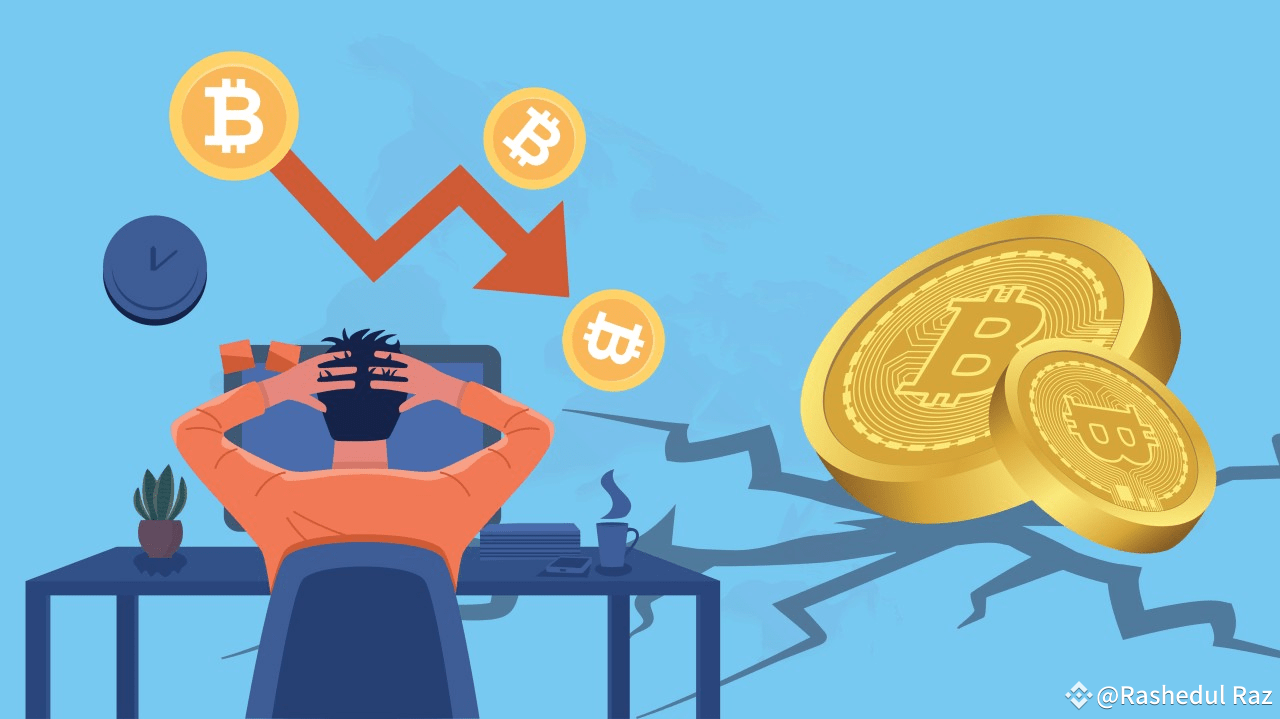
Crypto is one of the few markets where total beginners and experienced investors play the same game and the beginners almost always pay tuition in the form of avoidable losses. Most of those losses come from the same handful of mistakes. This guide names all of them.
Every week, someone new decides to put money into cryptocurrency for the first time. Some do their research. Most don't they've seen the headlines, heard from a friend, or watched a video that made it look straightforward. Then the market moves, something unexpected happens, and the learning curve arrives as a financial loss.
The frustrating reality is that the majority of money beginners lose in crypto isn't lost because of bad luck or an unpredictable market. It's lost because of specific, recognizable, entirely avoidable mistakes that experienced investors have already made and learned from years earlier.
This guide covers the most common ones plainly, so you don't have to pay for that education yourself.
How expensive beginner mistakes actually are
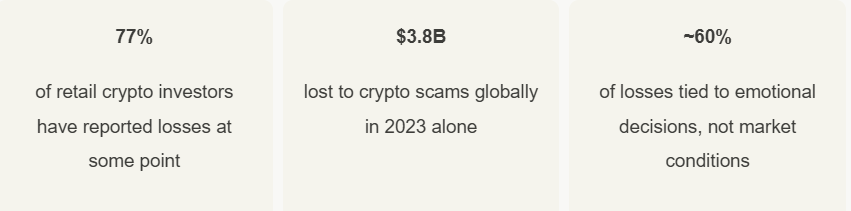
That last number is the important one. The majority of crypto losses aren't caused by the market doing something unexpected they're caused by investors doing something emotional. Fear, greed, and impatience are the real drivers of most beginner losses. Knowing that in advance changes how you approach every decision.
The mistakes — and how to avoid each one
1) Buying because of hype, not understanding
Most common
The most predictable pattern in crypto: a coin surges, it appears everywhere on social media, forums fill with people talking about how much they've made, and a new wave of buyers rushes in near the top right before a correction. This is called FOMO investing (fear of missing out), and it's the entry point for most beginner losses. The people promoting the loudest are almost always the people who bought earlier and need new buyers to sustain the price.
Fix
Before buying anything, ask: do I understand what this project does, why it has value, and what the realistic downside is? If you can't answer all three, it's speculation not investing. Speculation is fine in small amounts, but it should be a conscious choice, not a default.
2) Investing money they can't afford to lose
High impact
Crypto is genuinely volatile. A 40–60% price drop in a short period is not unusual it has happened multiple times with Bitcoin, the most established cryptocurrency, let alone smaller coins. Beginners who invest rent money, emergency funds, or borrowed money cannot hold through these drops. They are forced to sell at a loss at the exact moment the market is down, locking in losses that patient investors who could afford to wait eventually recovered from.
Fix
Only invest an amount you could watch drop 70% without it affecting your life or forcing you to sell. This isn't pessimism it's realistic risk management for an asset class that has demonstrated exactly this behavior repeatedly.
3) Leaving crypto on an exchange instead of a wallet
Security risk
When you buy crypto on an exchange like Coinbase or Binance, you don't technically own the crypto you own an IOU from the exchange. If the exchange is hacked, goes insolvent, freezes withdrawals, or collapses (as several major exchanges have), your funds can be lost or locked indefinitely. This has happened to millions of users. The phrase in crypto is: "not your keys, not your coins."
Fix
For any amount you're not actively trading, move it to a hardware wallet (Ledger or Trezor) or a self-custody software wallet where you control the private keys. Keep exchange balances to only what you need for active trading.
4) Putting everything into one coin
Concentration risk
Beginners often concentrate their entire crypto investment in one coin usually one that's recently performed well or that someone they trust recommended. Crypto assets are highly correlated but individual coins carry enormous idiosyncratic risk: regulatory action, developer abandonment, technical failures, or simply falling out of market favour can wipe out a single coin while the broader market recovers just fine.
Fix
Start with the most established assets Bitcoin and Ethereum account for the majority of total crypto market value for a reason. If you want exposure to smaller coins, limit them to a portion of your crypto allocation, not the whole thing.
5) Panic selling during a dip
Emotional decision
A coin drops 30% in a week. It feels urgent. It feels like you should do something. For many beginners, "doing something" means selling converting the paper loss into a real, permanent one. Then the coin recovers six weeks later, and the same person buys back in higher than they sold. This sequence buy high, panic sell low, rebuy higher is the exact pattern that generates most of the losses in beginner crypto portfolios, repeated in cycle after cycle.
Fix
Before you buy any crypto position, write down the specific conditions under which you would sell a price target, a time horizon, or a fundamental change in the project. Then only sell when those conditions are met. A written plan removes the emotional decision in the moment when emotions run highest.
6) Falling for scams disguised as opportunities
Irreversible
Crypto scams in 2026 are sophisticated. Fake exchanges, impersonator accounts of well-known investors, "guaranteed returns" platforms, romance scams involving crypto investment, and phishing sites that look identical to real wallets and exchanges have collectively cost billions. Unlike a bank transfer dispute, crypto transactions cannot be reversed once the funds are sent to a scammer's wallet, they are permanently gone.
Fix
Apply one rule universally: no legitimate investment platform guarantees returns, no real celebrity or investor will DM you about a special opportunity, and no one needs your seed phrase for any legitimate reason. If any of those appear, it is a scam 100% of the time.
7) Ignoring taxes on crypto transactions
Often overlooked
In most countries, selling crypto, trading one coin for another, and even using crypto to buy goods are taxable events. Many beginners assume crypto exists outside the tax system because it's digital and decentralized. It doesn't. Tax authorities in the US, UK, EU, and most major economies now receive transaction data from exchanges and treat crypto gains as taxable income or capital gains. Beginners who don't track their transactions find themselves with significant unexpected tax bills and sometimes penalties.
Fix
Track every transaction from the start using a crypto tax tool like Koinly or CoinTracker. The record-keeping is far easier done as you go than reconstructed months later. Consult a tax professional if you're making significant trades.
The rules experienced investors actually follow
After years in the market, most experienced crypto investors converge on a similar set of principles not because they read them somewhere, but because they learned them through losses.
Rule Only invest what you'd be comfortable losing entirely. This isn't a disclaimer it's the operating principle that allows you to make rational decisions when the market gets irrational.
Rule Boring is profitable. The most consistent long-term strategy in crypto isn't finding the next 100x coin it's dollar-cost averaging into established assets and not touching them. Small, regular purchases across weeks and months average out volatility and remove the impossible task of timing the market.
Rule The loudest voices online are the most conflicted. People promoting a coin loudly on social media almost always hold that coin. Their financial interest is in you buying it, not in giving you honest investment advice. Weight information from anonymous online sources accordingly.
Rule Crypto is a complement to a financial plan, not the plan itself. The people who have built durable wealth that included crypto did so with an existing financial foundation emergency fund, low consumer debt, diversified investments. They added crypto as a higher-risk portion of a broader portfolio, not as a replacement for conventional financial planning.
The one thing that separates the people who stay from those who leave
Most people who lose money in crypto and never return made the same mistake: they treated their first experience as a test of whether crypto "works" rather than as a test of their own process and preparation.
The market didn't fail them. Their approach did. And an approach can be fixed.