Financial Spring Cleaning: 10 Money Moves to Make This Month

Moves 1–3 Cut the Waste
Stop Paying for Things You Forgot You Had
1) Audit Every Subscription You're Paying For
The average person pays for 4–6 subscriptions they rarely or never use. Streaming services, fitness apps, cloud storage upgrades, magazine bundles, software trials that auto-renewed they all add up to a quiet drain that most people never review.
Go through your last two bank statements line by line. Highlight every recurring charge. Cancel anything you haven't used in the last 30 days. Tools like Rocket Money or Trim can scan your accounts and surface subscriptions you've completely forgotten about.
⚡ Action: Set a 20-minute timer and do this tonight
2) Call Your Insurance Company and Ask for a Better Rate
Most people set up car, renters, or home insurance and never revisit it. But loyalty rarely pays in insurance companies regularly offer lower rates to new customers than they give long-term ones. Call your current provider, say you're shopping around, and ask what they can do. Then actually shop around using comparison sites.
Switching providers or adjusting your deductible could reduce your annual premium by $200–$600 for the exact same coverage.
⚡ Action: Get at least two competitor quotes this week
3) Review Your Phone Plan
Telecom companies quietly raise prices and add fees. If you haven't reviewed your mobile plan in over a year, you're almost certainly overpaying. Prepaid carriers like Mint Mobile, Visible, and Google Fi offer the same reliable networks as the major carriers at 30–50% less per month with no contracts.
⚡ Action: Check your current plan vs. one prepaid alternative
Moves 4–6 Build the Foundation
Make Sure the Basics Are Actually Working
4) Build or Replenish Your Emergency Fund
Financial advisors recommend keeping 3–6 months of living expenses in a liquid, accessible savings account. If you don't have this yet or if life dipped into it this is your top priority. Even starting with a $500 emergency fund dramatically reduces the chance that one unexpected expense sends you into credit card debt.
The best place to keep it? A high-yield savings account (HYSA). Many online banks now offer 4–5% APY far better than the 0.01% most traditional banks still offer. SoFi, Marcus, and Ally are consistently well-rated options.
⚡ Action: Open a HYSA if you don't already have one
5) Check Your Credit Report for Errors
One in five Americans has an error on their credit report and errors can drag your score down by dozens of points, costing you thousands in higher interest rates over time. You're entitled to one free report from each of the three bureaus annually at AnnualCreditReport.com.
Look for accounts you don't recognize, incorrect payment history, wrong personal information, and duplicate entries. Dispute anything inaccurate directly with the bureau online the process is faster than most people expect.
⚡ Action: Pull your free report this week and review it
6) Increase Your Retirement Contribution - Even by 1%
If your employer offers a 401(k) match and you're not contributing enough to capture the full match, you're leaving free money behind. If you already capture the match, consider bumping your contribution by just 1%. On a $50,000 salary, 1% is roughly $42/month but compounded over 20–30 years, that small increase can add tens of thousands of dollars to your retirement balance.
⚡ Action: Log into your benefits portal and check your contribution rate
The 1% rule: Every time you get a raise this year, increase your savings or retirement contribution by 1% before you adjust your lifestyle to the higher income. You'll never miss money you didn't have yet.
Moves 7–10 Optimize and Grow
Squeeze More From Every Dollar You Already Have
7) Renegotiate Your Biggest Bills
Internet, cable, gym membership, and even medical bills are often negotiable most people just never ask. Call your internet provider and tell them you're considering switching. Ask your gym about annual payment discounts. If you have medical debt, call the billing department and ask about hardship plans or reduced-balance settlements. Providers would rather take less than send a bill to collections.
This single move is where people most consistently save $500–$1,500 per year with a handful of phone calls.
⚡ Action: Pick your three biggest monthly bills and call each one
8) Automate Your Savings So Willpower Isn't Required
The most reliable way to save money isn't discipline it's automation. Set up an automatic transfer from your checking account to your savings account the day after your paycheck hits. Even $50–$100 per paycheck builds a meaningful cushion over time without you thinking about it.
Out of sight, out of mind works in your favor here. People who automate savings consistently save more than those who try to save what's "left over" at month's end because there's rarely anything left over.
⚡ Action: Set up one automatic savings transfer today
9) Make Sure Your Money Is in the Right Accounts
Is your emergency fund sitting in a traditional savings account earning next to nothing? Are you holding cash in a checking account when it could be working harder in a HYSA or a money market account? Are you keeping money you won't need for 10+ years in cash when it could be invested?
Each dollar you own should have a job. Short-term savings belong in high-yield accounts. Long-term wealth belongs in diversified investments. Money you need immediately stays liquid. Doing a quick account audit is one of the highest-ROI tasks in personal finance.
⚡ Action: Map out where each savings bucket currently lives
10) Set One Specific Financial Goal for the Next 90 Days
Vague goals "save more money," "spend less," "get my finances in order" don't work because they have no finish line. This month, set one specific, measurable financial goal with a 90-day deadline. Pay off a specific credit card. Save $1,000 toward your emergency fund. Cut dining out to twice a week.
Write it down. Tell someone about it. Put a reminder on your phone. People who write down specific financial goals are significantly more likely to achieve them than those who keep it as a vague intention.
⚡ Action: Write your 90-day goal down right now
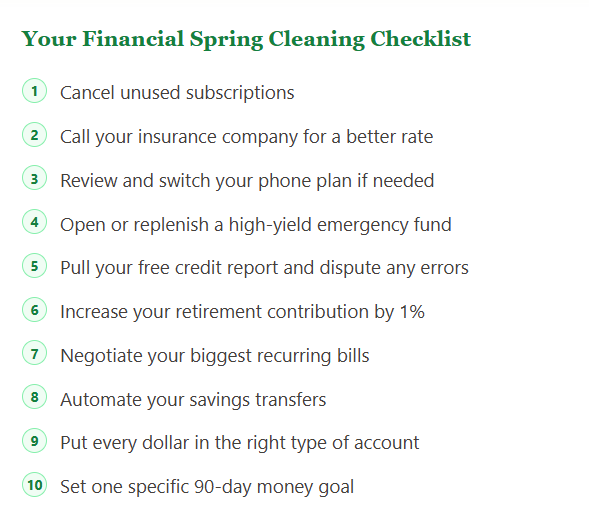
Financial spring cleaning isn't about overhauling your entire money life in a weekend. It's about making small, deliberate improvements one at a time that compound into significantly better financial health by year's end. Pick two or three moves from this list and start today. The best financial decision is always the one you actually make.