How to Land a Job With No Experience (Entry-Level Guide)

Everyone starts somewhere but nobody tells you how. If you're staring at job listings that all seem to require "2–3 years of experience" for roles labeled entry-level, you're not imagining it. This guide gives you a clear, actionable path forward even if your resume is nearly blank.
Why "No Experience" Doesn't Mean No Chance
Here's something most job-seekers don't realize: employers posting entry-level roles know they're hiring people without professional experience. What they're actually screening for is reliability, attitude, transferable skills, and evidence that you can learn. Your job is to show all four even without a work history.
The mistake most beginners make is leading with what they don't have. Every section of this guide is about flipping that around and showing what you do bring to the table.
1 Build a Resume That Works Without a Work History
A blank employment section doesn't have to sink your application. The key is knowing what to put in its place and how to frame what you already have.
- Education: List relevant coursework, academic projects, or certifications even if they're free online courses (Google Career Certificates, Coursera, HubSpot Academy). These signal initiative.
- Volunteer work: Organized a school event? Helped at a local non-profit? That counts. Frame it with action verbs and results: "Coordinated a 3-day fundraiser for 200+ attendees."
- Personal projects: Built a website? Ran a social media page? Sold things on Etsy or eBay? These demonstrate real skills include them.
- Soft skills with proof: Don't just list "communication skills." Give evidence: "Tutored three classmates in mathematics over one semester, all improving their grades by at least one letter."
Resume tip: Keep your resume to one page. Use a clean, simple template no graphics or fancy fonts. Many companies use Applicant Tracking Systems (ATS) that can't read complex formatting, and your resume may never reach a human eye if it gets filtered out.
2 Write a Cover Letter That Actually Gets Read
Most applicants skip the cover letter or write a generic one. This is your biggest opportunity to stand out when your resume is thin.
A cover letter that works does three things: it opens with something specific about the company (not "I am applying for the position of..."), it explains why you want this particular role rather than just any job, and it connects what you've done even informally to what the employer needs.
Keep it to three short paragraphs. Sound like a person, not a template. Hiring managers read dozens of these in a sitting the ones that feel human get remembered.
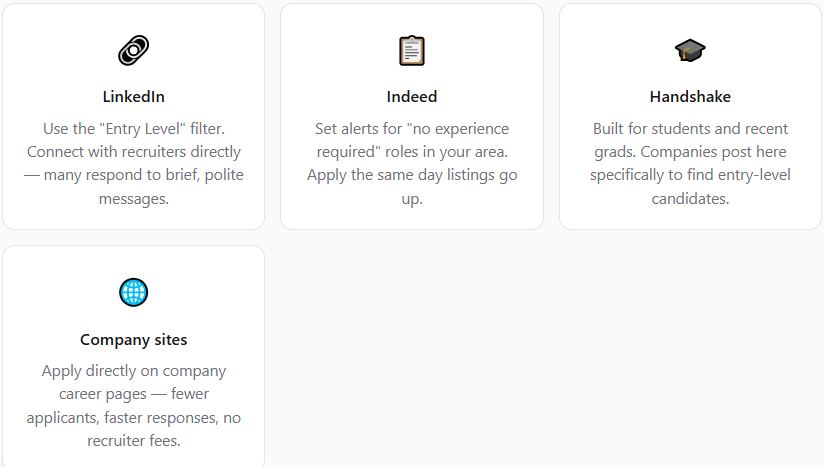
3 Use the Right Job Search Platforms for Entry-Level Roles
Not all job boards are equal when you're starting out. Some are built for experienced professionals. Others are goldmines for beginners.
4 Get Experience Before You Have a Job
This sounds contradictory, but it's one of the most powerful moves you can make. You don't need to wait for someone to hire you to start building a track record.
- Freelance for free (briefly): Offer your skills to a local small business or non-profit at low or no cost in exchange for a testimonial and work samples. One real project beats ten bullet points.
- Internships and apprenticeships: Many are paid. Even unpaid ones often convert to full-time roles or provide strong references. Search specifically for "paid internships for beginners" in your field.
- Online certifications: A Google Data Analytics Certificate, a Meta Social Media Marketing Certificate, or an AWS Cloud Practitioner certification can make a blank resume look genuinely impressive to a hiring manager and most take under six months to complete.
- Gig work as a bridge: Platforms like Upwork, Fiverr, and TaskRabbit let you earn money and build a portfolio simultaneously, even while job hunting.
5 Network - Even If You Think You Have No Network
Studies consistently show that the majority of jobs are filled through referrals and personal connections before they're ever publicly listed. This isn't who you know it's who knows you're looking.
Tell everyone: former teachers, coaches, neighbors, family friends, old classmates. LinkedIn makes this easier than ever you can post a simple, professional update letting your network know you're actively job searching. You'd be surprised who responds.
Informational interviews are another underused tool. Reach out to someone working in a role you want and ask for a 15-minute call to learn about their career path. Most people are happy to help, and these conversations regularly turn into job leads.
Networking tip: Send a short, specific message not a generic "can we connect?" Try: "I'm a recent grad exploring careers in marketing. I came across your work at [Company] and would love to ask you two or three questions about how you got started. Would you have 15 minutes sometime this month?"
6 Prepare for Interviews With No Experience to Reference
When an interviewer asks "tell me about a time you handled a difficult situation," you don't need a workplace story. School projects, sports, part-time babysitting, managing a difficult family situation life experience is valid experience. Use the STAR method: Situation, Task, Action, Result.
Research the company thoroughly before every interview. Know their mission, recent news, and who their competitors are. Ask smart, prepared questions. Candidates who understand the company before walking in the door stand out dramatically most people don't bother.
The short version: what actually moves the needle
✓ A one-page, ATS-friendly resume that highlights skills and projects over employment history
✓ A specific, human-sounding cover letter - not a template
✓ Certifications and personal projects that prove you can do the work
✓ Applying to the right platforms where entry-level roles actually live
→ Telling everyone you're looking most jobs are filled before they're posted
→ Practicing STAR-method interview answers using real-life stories, not just work stories
The Bottom Line
Landing a job with no experience is genuinely harder than it used to be but it's far from impossible. The candidates who succeed aren't the ones with the best background. They're the ones who show up prepared, make it easy for employers to see their potential, and don't give up after the first few rejections.
Start with one step from this guide today. Update your resume. Reach out to one person. Apply to one role. Momentum builds fast once you start moving and your first job is closer than it feels right now.