Is Dropshipping Still Worth It in 2026? The Honest Answer
Dropshipping has been declared dead at least a dozen times since 2018. It hasn't died. But it has changed and the version that worked in 2019 looks almost nothing like what's working now. Here's the real picture.
Search "is dropshipping dead" and you'll find two equally loud camps: people insisting it's completely finished, and people selling courses claiming it's easier than ever. Both are exaggerating for their own reasons.
The honest answer is more nuanced and more useful. Dropshipping as a business model is very much alive in 2026. But the low-effort, copy-a-product-from-AliExpress version that flooded the internet between 2017 and 2021 is genuinely not viable anymore. The market has moved. The question is whether you're willing to move with it.
This article gives you a clear-eyed look at what's changed, what still works, and how to know whether dropshipping is worth your time specifically without the hype in either direction.
What actually changed and what didn't
The core mechanics of dropshipping haven't changed: you sell a product online, a supplier ships it directly to the customer, and you keep the margin. No inventory, no warehouse, low upfront capital. That model still functions.
What changed is the environment around it.
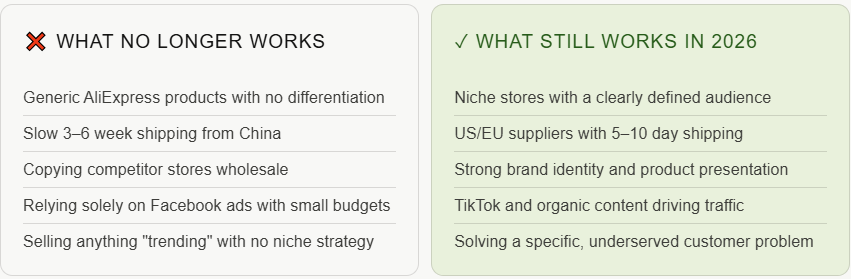
The dropshippers who failed treated it as a shortcut. The ones still earning treated it as a real business one that required positioning, customer experience, and genuine marketing. That distinction explains most of the difference in outcomes.
The real numbers: what to expect in 2026
One of the most damaging things about dropshipping content online is unrealistic income claims. Course sellers show screenshots of $50,000 months. They don't show the $40,000 in ad spend, the refunds, the supplier issues, or the months of losses before getting there.
Realistic expectations for a beginner: Most people who start dropshipping in 2026 with no prior experience take 3–6 months before making consistent profit. Early months often involve testing products at a loss. Profitable stores typically run at 10–25% net margin after ad costs, supplier fees, and platform fees. A store generating $10,000/month in revenue may net $1,500–$2,500. That's real money but it's not passive, and it doesn't happen in week one.That said, compared to most other online business models, dropshipping has a genuinely low barrier to entry. You don't need to manufacture a product, hold inventory, or invest large amounts of capital upfront. The risk profile for a careful beginner is lower than most alternatives as long as expectations are grounded in reality.
The niches where dropshipping is still profitable in 2026
Niche selection is the single most important decision in dropshipping. General stores are almost impossible to market profitably now. Specific, problem-solving niches still have real opportunity.
🐾 Pet products (specific breeds or problems)
Strong demand
Pet owners spend consistently and emotionally. Stores targeting specific breeds or specific problems anxiety in dogs, joint supplements for older cats, training tools for puppies outperform general pet stores by a wide margin. The specificity makes targeting cheaper and conversion rates higher.
🏠 Home organization & space-saving products
TikTok-friendly
Products that visually solve a relatable problem perform exceptionally well on TikTok and Instagram Reels which means free organic traffic on top of paid ads. Space-saving kitchen organizers, cable management solutions, and clever storage products are demonstrated easily in short videos, making content creation straightforward even without professional production skills.
💪 Health, fitness & recovery tools
Competitive but profitable
The health and wellness space is competitive but buyers in this niche spend freely and return repeatedly. Products targeting specific pain points posture correction, sleep improvement, recovery tools for runners or office workers have clear, searchable audiences and strong content potential. The key is finding a supplier with quality products and reasonable shipping times, which rules out most generic AliExpress options.
👶 Baby and parenting products
Recession-resistant
Parents are among the most reliably high-intent buyers online. Products that solve a specific parenting challenge sleep routines, feeding, developmental play, travel with infants sell consistently regardless of economic conditions. This niche also responds well to educational content marketing, giving organic traffic channels a strong foothold alongside paid advertising.
The honest reasons most dropshipping stores fail
Understanding why stores fail is as important as knowing which niches work. The most common failure points in 2026 are predictable and almost all of them are avoidable.
Mistakes:
Testing too many products without enough budget. Spreading $500 across 10 products means none get a fair test. Concentrating resources on 1–2 well-researched products produces far better data and results.
Ignoring the customer experience entirely. Slow shipping, no tracking updates, poor return policies, and unresponsive support destroy repeat business and generate chargebacks. In 2026, customers expect Amazon-level service even from small stores.
Choosing a supplier based on price alone. The cheapest supplier is often the most expensive in the long run through refunds, disputes, and one-star reviews. Vetting suppliers with test orders before launching is not optional; it's the foundation of a store that survives its first 90 days.
Quitting after the first failed product. Almost no successful dropshipper found a winning product on their first try. The model requires methodical testing treating each product test as data collection, not a verdict on whether the business works.
How to start dropshipping in 2026 the right way
- Choose a niche before choosing a product
Define your target customer first who they are, what problem they have, where they spend time online. Then find products that serve that person. This order matters enormously: niche-first stores market more cheaply and convert more reliably than product-first stores.
- Source from US or EU suppliers, not only China
Platforms like Spocket, Zendrop, and AutoDS connect you with suppliers offering 5–10 day shipping to US and European customers. This alone eliminates the biggest complaint modern customers have about dropshipping stores and dramatically reduces refund rates.
- Build organic traffic alongside paid ads from day one
A TikTok or Instagram account showing your products in use costs nothing but time and can drive significant traffic without ad spend. Stores that combine organic content with targeted paid advertising have lower customer acquisition costs and survive ad account bans which happen more than most beginners expect.
- Set a testing budget and treat it as tuition
Approach your first $500–$1,000 as the cost of learning, not the cost of winning. Your goal in the first 60–90 days isn't profit it's finding one product that converts and understanding your customer acquisition cost. Profit follows from there.
So is it worth it in 2026?
For someone willing to treat it as a real business doing niche research, vetting suppliers properly, building a brand rather than just a store, and persisting through the product-testing phase yes, dropshipping is still a viable way to build an online income stream in 2026.
For someone looking for a passive income machine that requires minimal effort and delivers results in a few weeks - no. That version of dropshipping never really existed, and the market in 2026 is far less forgiving of shortcuts than it was five years ago.
The honest filter: Before starting, ask yourself am I willing to spend 3–6 months testing, learning, and possibly losing small amounts of money before seeing consistent profit? If yes, the model works. If you need results in 30 days, there are better options for your situation.