Print on Demand: Is It Still Worth It in 2026?
Print on demand once felt like the ultimate low-risk business model no inventory, no upfront costs, and passive income while you slept. But in 2026, the landscape has shifted. Here's the honest, no-fluff answer to whether it's still a viable way to make money online.
What Is Print on Demand - and How Does It Work?
Print on demand (POD) is a business model where you design products t-shirts, mugs, hoodies, phone cases, posters and a third-party supplier prints and ships them only when a customer places an order. You never touch inventory. You never pay upfront. You keep the difference between the retail price you set and the base cost the supplier charges.
Platforms like Printful, Printify, and Gelato integrate directly with marketplaces such as Etsy, Shopify, and Amazon Merch on Demand. The appeal is obvious: anyone with a design idea and an internet connection can start a store in a single afternoon.
Is Print on Demand Saturated in 2026?
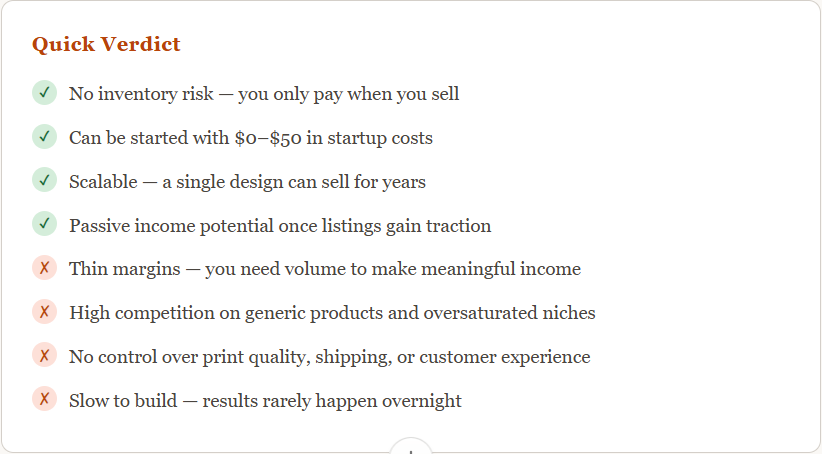
Let's address the big question first: yes, POD is more competitive than it was in 2019 or even 2022. Generic designs a motivational quote on a white tee, a sunflower on a canvas tote no longer move. The low barrier to entry that made POD so attractive also meant millions of sellers flooded the market with similar, unremarkable products.
But "saturated" doesn't mean "dead." It means the strategy has to evolve. Sellers who are genuinely thriving in 2026 share one thing in common: they're targeting specific, passionate niches instead of trying to appeal to everyone.
The shift that matters: Broad + generic = invisible. Narrow + specific = profitable. A mug that says "Coffee Lover" competes with 200,000 listings. A mug designed for left-handed veterinary nurses who love dark humor? That's a different story.
What Are the Realistic Profit Margins in 2026?
This is where beginners often get a rude awakening. Print on demand profit margins are thin typically between $3 and $8 per item sold after the supplier takes their cut. On a $24.99 t-shirt, you might pocket $6–$8. That's not bad per sale, but it underscores why volume and traffic are everything.
The real profit killers are paid ads. If you're running Facebook or TikTok ads to drive traffic, costs can easily swallow your margins. That's why the most sustainable POD businesses in 2026 are built on organic traffic primarily through Etsy SEO, Pinterest, and short-form video content that showcases the products naturally.
- Etsy remains one of the best platforms for POD because buyers come to it with purchase intent
- A well-optimized Etsy listing targeting low-competition keywords can generate consistent passive sales without paid ads
- Sellers using TikTok and Instagram Reels to show "design process" or "unboxing" content have dramatically cut their customer acquisition costs
How to Start a Print on Demand Business That Actually Makes Money
If you're going to start in 2026, here's the approach that separates the stores that earn from the ones that collect dust:
1. Pick a niche you can own. Don't just pick a niche pick an intersection. Not "dog lovers," but "golden retriever owners who are also nurses." Not "gym motivation," but "powerlifters who hate cardio." The more specific, the less competition and the more loyal your buyers.
2. Validate before you scale. List 10–20 products on Etsy with strong SEO-optimized titles and tags. Watch what gets clicks and favorites. Let the market tell you what it wants before you invest time creating 200 designs.
3. Design for your buyer, not for yourself. The best-selling POD products solve an identity problem they let the buyer say something about who they are. Ask yourself: would someone proud to wear this, gift this, or display this?
4. Optimize for search, not just aesthetics. A beautiful product with a poorly written listing won't sell. Research what your target customer types into search bars and build your titles, tags, and descriptions around those exact phrases.
5. Treat it like a business, not a lottery ticket. Beginners often list 20 designs, get no sales in the first two weeks, and quit. POD on Etsy can take 60–90 days to gain traction as listings get indexed and accumulate views.
The Honest Pros and Cons of Print on Demand in 2026
So - Is Print on Demand Still Worth It in 2026?
Yes - but only if you're willing to approach it strategically. The days of slapping a quote on a t-shirt and watching money roll in are over. What works now is tight niche targeting, genuine design creativity, strong SEO fundamentals, and patience.
For anyone looking for a low-cost side hustle that can grow into a real income stream over 6–12 months, print on demand is still one of the most accessible options available. It's not a get-rich-quick scheme it never was but with the right approach, it remains a legitimate way to build income online in 2026.
The people failing at print on demand are the ones treating it casually. The ones succeeding are treating it like a real business.
Bottom line: Don't ask "is POD worth it?" Ask "am I willing to put in the work to make it work?" If yes — the opportunity is absolutely still there.